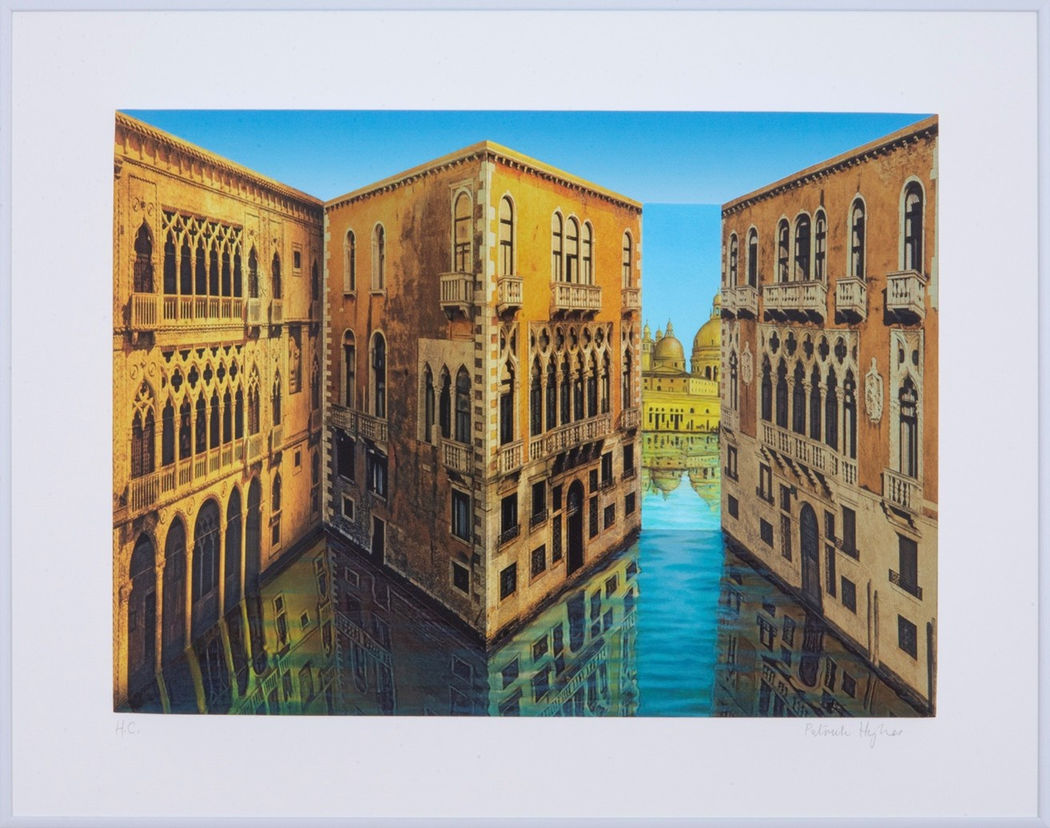
Patrick Hughes, Golden, 2022. Hand-painted multiple with archival inkjet
Patrick Hughes and the Art of Reverspective
For over six decades, Patrick Hughes has defied the conventional logic of vision, turning the rules of perspective on their head and establishing himself as one of the most distinctive and intellectually mischievous figures in contemporary British art. Best known for his invention of "reverspective"- a mind-bending technique that combines three-dimensional relief constructions with painted perspective - Hughes invites viewers to question not just what they see, but how they see. His works don’t simply depict illusions; they become illusions, shifting and shimmering in real time as the viewer moves, forcing an active relationship between the artwork and its audience. At Andipa Editions, we’ve long been drawn to Hughes’ work not only for its optical wit, but for the deeper inquiries it makes into perception, memory, and the philosophical architecture of visual experience.
Born in Birmingham in 1939, Hughes emerged into a post-war Britain rethinking its cultural and artistic identity. While many of his contemporaries were moving toward abstraction, minimalism, or conceptualism, Hughes carved his own curious path, one steeped in paradox, humour, and literary reference. His early career saw him working as a painter, illustrator and educator, but it was in the 1960s that his interest in visual contradiction truly began to crystallise. His early works played with linguistic games and pictorial puzzles, but it wasn’t until the 1980s that he fully realised his now-signature reverspective format. Reverspective, a portmanteau of "reverse" and "perspective", emerged from Hughes’ longstanding interest in how space is constructed and perceived. The idea was as radical as it was simple: rather than painting a flat canvas to look three-dimensional, Hughes constructed physical protrusions from the wall and painted them to appear as if they were receding. The result is a visual paradox, scenes that appear to stretch back into the distance are in fact jutting out towards the viewer. As one moves past them, the illusion intensifies: gallery walls twist, libraries lurch forward, Venetian canals sweep unnaturally across space. It is as if the laws of perspective have been hijacked by an impish master of ceremonies.
Philosophy and Influences Behind Hughes’ Work
Yet Hughes’ work is not only about clever tricks of the eye. Underpinning the optical effects is a rich philosophical inquiry. He is an artist deeply engaged with how the brain constructs the world - and how easily that construction can be fooled. Drawing on influences ranging from the Renaissance masters of perspective to Surrealism, Gestalt psychology, and the writings of Ludwig Wittgenstein, Hughes creates works that are as intellectually layered as they are visually arresting. In many ways, his reverspectives are both paintings and sculptures, both objects and images, a duality that resists fixed categorisation. Hughes’ love of paradox extends beyond geometry and into language, symbolism, and cultural reference. His cityscapes often pay homage to art history’s greats: René Magritte, Giorgio de Chirico, Marcel Duchamp and M.C. Escher all appear within Hughes’ visual lexicon, either as direct subjects or conceptual echoes. In his works, we often find references to familiar scenes, a long hallway, a book-lined study, a Roman colonnade, but these are never straightforward representations. Instead, they are reimagined as vessels of visual inquiry, offering viewers a momentary, if disorienting, glimpse into the mechanics of perception.
Patrick Hughes’ Prints, Legacy, and Collector Appeal
As a printmaker, Hughes has continued to explore the possibilities of reverspective through editioned works, many of which are held in prominent collections around the world. Working across lenticular prints, limited-edition 3D constructions, and complex screenprints, Hughes extends his investigations into multiple mediums, showing that illusion is not the domain of painting alone. His editions allow collectors to experience the dynamic engagement of reverspective on a more intimate scale - bringing his visual sleights-of-hand into the domestic or private space.
Hughes’ career has also been defined by his generosity as a communicator. A natural teacher and thinker, he has written extensively on art and perception, including his 1975 book Upon the Pun: Dual Meaning in Words and Pictures, which explores visual puns, double meanings and playful ambiguity. His writings and lectures have made him a beloved figure not just in galleries but in universities, artist studios and philosophy departments, anywhere, in fact, where people are curious about how meaning is made.
Now in his eighties, Hughes remains remarkably active, producing new works that continue to astonish and delight. His influence can be seen across generations of artists who explore illusion, perception and space, not as gimmick, but as subject matter in its own right. In a culture increasingly dominated by flat screens and digital simulations, Hughes’ physical, handmade constructions feel like powerful counterpoints: they are not representations of movement, but embodiments of it; not passive images, but experiential events.
Ultimately, the art of Patrick Hughes endures because it never stops asking questions. It encourages us to doubt what we think we know, to approach the visual world with fresh eyes, and to find pleasure in the tension between what is seen and what is true. For collectors and audiences alike, Hughes offers more than a visual spectacle- he offers an invitation to think, to play, and to look again. At Andipa Editions, we’ve had the privilege of offering Hughes’ works for many years, and we continue to be fascinated by how they resonate with collectors. There is something enduringly contemporary about his practice: in an age of deepfakes, augmented reality, and digital manipulation, Hughes reminds us that the eye is not a camera, it is a storyteller, one that can be charmed, tricked, or made to reconsider its own narrative. This tension between appearance and reality, between artifice and experience, is what gives his work such lasting impact.
Summer in Full Colour runs at Andipa until 30 August 2025. If you would like to buy or sell a print or original painting by Patrick Hughes please contact sales@andipa.com or +44 20 7581 1244
