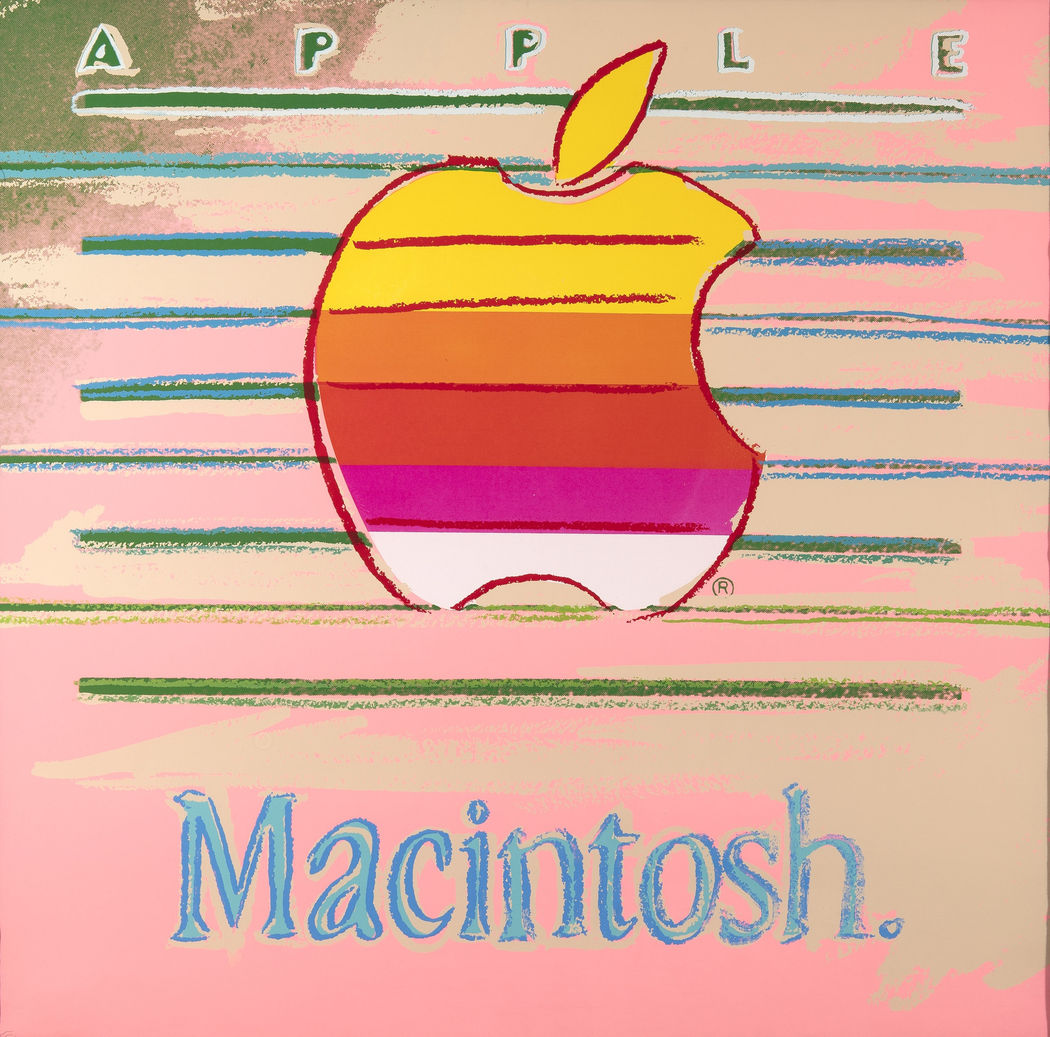
Apple (Macintosh) from Ads (F&S ll.359), 1985
Andy Warhol and the Apple Macintosh: A Digital Vision
When Andy Warhol first encountered the Apple Macintosh in 1984, he recognised something few others did—that technology was about to become the new canvas. At a time when computers were still seen as the domain of scientists and corporate offices, Warhol saw them as instruments of creation, mass communication and self-expression. He understood instinctively that the digital screen would replace the silkscreen as the defining surface of modern life. His brief but illuminating relationship with Apple, culminating in his Ads series of 1985, remains one of the most prescient and fascinating episodes of his career. For collectors, these works stand as a bridge between Pop Art and the digital age—a rare fusion of glamour, commerce and the dawning of a new technological consciousness.
Warhol’s Fascination with Reproduction and Technology
Warhol had always been fascinated by the tools and languages of reproduction. His use of the silkscreen in the early 1960s—mechanical, repetitive, commercial—anticipated the pixel long before the digital era arrived. He said, “I want to be a machine,” not out of irony but out of a genuine fascination with the way technology could remove the trace of the artist’s hand. To Warhol, the machine was not a threat to creativity but a collaborator, a way to democratise art by making it reproducible and available to all. When he was invited to preview the Apple Macintosh shortly after its launch, that philosophy found its next medium. Witnesses at the event recall Warhol experimenting on stage, nervously sketching Debbie Harry on the computer screen, marvelling at its capacity for instant image-making. What he saw was not just a gadget—it was the logical evolution of his lifelong preoccupation with speed, repetition, and fame.
The Ads Portfolio of 1985
That encounter, and Warhol’s friendship with Steve Jobs’ contemporaries in the New York creative world, directly inspired the Ads portfolio of 1985. The series revisits the language of mass advertising—Volkswagen, Chanel, Paramount, Mobilgas, Apple Macintosh—and elevates it into fine art. Each image is drawn from the visual vernacular of commerce, reimagined through Warhol’s electric palette and characteristic silkscreen technique. Yet while his earlier works had blurred the line between art and consumer product, the Ads series reflects a new awareness: that by the mid-1980s, technology and media had merged into something larger than commerce. They had become culture itself.
Apple Macintosh Print: A Prophetic Icon
The Apple Macintosh print is among the most striking and prophetic of the series. The original advertisement, designed to celebrate the launch of the first personal computer, positioned the Mac as revolutionary - “the computer for the rest of us.” Warhol’s interpretation retains the logo, the iconic rainbow apple, and the glowing screen, but his treatment transforms it into something mythic. The composition vibrates with colour: turquoise, magenta, ochre, and green collide across the surface, suggesting both optimism and chaos. It is as if Warhol were declaring the arrival of a new kind of icon—no longer the movie star or the soup can, but the technology brand. For collectors, this work encapsulates a pivotal cultural shift: from Pop Art’s fascination with products to a postmodern fascination with systems, data, and design.
Bridging Pop Art and the Digital Era
What makes the Apple Macintosh piece so compelling is the way it bridges eras. In one sense, it follows directly from Warhol’s earlier commercial subjects—Campbell’s Soup, Brillo Boxes, Coca-Cola—celebrating the beauty of consumer design. Yet, unlike those mid-century products, the Mac symbolised something intangible: information, creativity, connection. Warhol intuitively sensed that the computer would blur boundaries not just between art and commerce, but between artist and audience. The Macintosh, like Warhol’s Factory, was a place of participation and production. Anyone could create, anyone could copy, anyone could share. In that sense, the Apple Macintosh silkscreen is both a celebration and a prediction—a glimpse of a world where every individual becomes a producer of images, a Warholian reality that defines our age.
Warhol’s Early Experiments in Digital Art
Warhol’s relationship with technology went beyond this single print. He experimented with early digital drawing programs on the Amiga computer, producing some of the earliest examples of computer-generated fine art. In these pixelated sketches—of flowers, self-portraits, and Campbell’s Soup Cans—Warhol explored how the logic of Pop could be reborn in the digital domain. The pixel, like the silkscreen dot, became a unit of replication and variation. Decades later, these works, rediscovered on a set of Amiga floppy disks, revealed just how visionary he had been. They were not novelties; they were early signals of the digital art movement that would explode with the internet, NFTs, and AI. For collectors today, they demonstrate that Warhol was not simply reflecting his time—he was mapping the future.
Corporate Logos as Modern Icons
The Ads series, and particularly the Apple Macintosh print, can be seen as Warhol’s final commentary on the nature of image and power. By the 1980s, corporations had replaced monarchs and movie stars as the new icons of mass devotion. Apple, Chanel, Paramount—each logo was a contemporary coat of arms, designed to inspire loyalty, aspiration and belonging. Warhol, ever the cultural anthropologist, captured this shift with precision. In turning corporate logos into artworks, he blurred the distinction between consumerism and religion, suggesting that branding itself had become the new mythology. The Apple logo, bitten and rainbow-striped, was as recognisable and worshipped as the face of Marilyn Monroe.
Collectors’ Perspective
For Andipa collectors, Warhol’s Apple Macintosh and Ads portfolio hold a unique place in his body of work. They mark the moment when Pop Art transcended the physical world of products and entered the digital imagination—a world we now inhabit fully. These works resonate deeply today, not only because of their bold colour and graphic sophistication, but because they capture the birth of our contemporary condition: a society mediated by screens, driven by technology, and obsessed with the intersection of design and identity.
Warhol once remarked, “Computers are beautiful.” It was a deceptively simple statement, but within it lies the essence of his vision. He understood beauty not as form alone, but as the embodiment of culture—whatever medium that culture might take. In the 1960s, beauty was a Coke bottle; in the 1980s, it was the Macintosh; today, it might be the smartphone or the algorithm. Warhol’s genius was to look at these inventions and see not machines, but mirrors. They reflected who we were and who we were becoming. The Apple Macintosh print remains one of the most eloquent expressions of that vision—a portrait of technology as art, and art as technology, forever entwined.
