
Andy Warhol
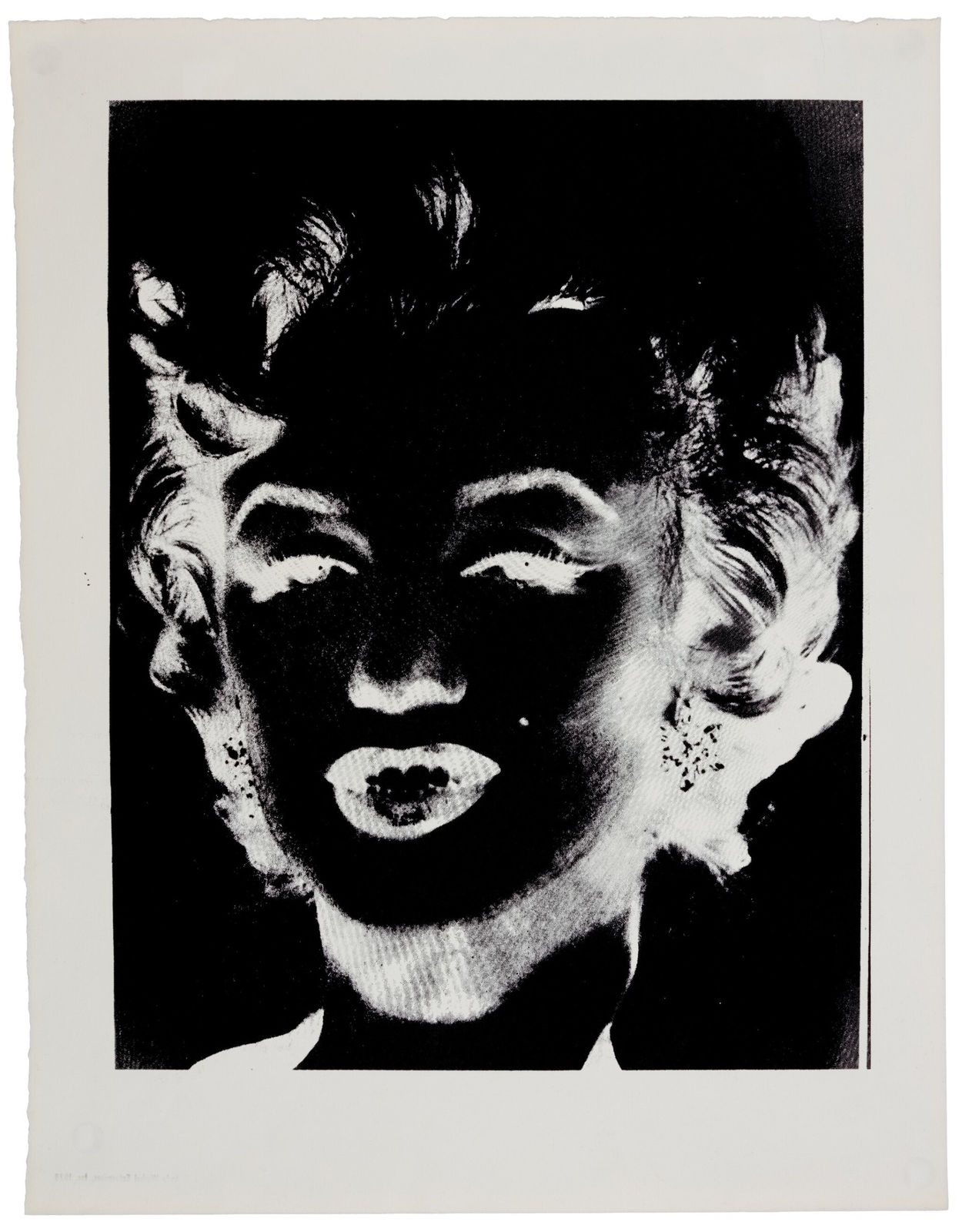
Marilyn Monroe (Marilyn) Reversal (F & S III.3), circa 1978
Unique silkscreen in black on Curtis Rag paper
Image: 46 x 35.9 cm.
18 x 14 in.
Sheet: 56.8 x 44.1 cm.
22 1/2 x 17 1/2 in.
18 x 14 in.
Sheet: 56.8 x 44.1 cm.
22 1/2 x 17 1/2 in.
Unique in its format. From the unpublished personal projects in circa 1978
Unsigned
Stamped on verso lower left by Andy Warhol Enterprises, Inc.
Stamped on verso lower left by Andy Warhol Enterprises, Inc.


The unpublished Marilyn Monroe “Reversal” prints from around 1978 occupy a fascinating and intimate place within Andy Warhol’s late printmaking practice. They belong to what the catalogue raisonne classifies as...
The unpublished Marilyn Monroe “Reversal” prints from around 1978 occupy a fascinating and intimate place within Andy Warhol’s late printmaking practice. They belong to what the catalogue raisonne classifies as his “Personal Projects”: works created outside the commercial edition structure, often printed for his own interest, for close friends, or simply to explore an idea without the constraints of publishing, numbering, or gallery commitments. These prints sit apart from the well-known editioned suites, rarities that offer a rare glimpse into Warhol’s studio thinking.
By the late 1970s Warhol was returning to several of his most iconic images, and Marilyn, arguably the image that made him, was foremost among them. Having first immortalised her in the early 1960s and again in the 1967 portfolio, he revisited her not to repeat but to rethink. The “Reversal” works take the familiar source photograph and invert it: the photographic negative becomes the composition, dark becomes light, glamour becomes ghostly. This act of reversal is both technical and conceptual. It exposes the mechanics of silkscreen, draws attention to the photographic root of the image, and reframes Marilyn not as an endlessly reproduced Pop icon but as a spectral afterimage, a meditation on fame, memory, and the erosion of celebrity.
This moment in 1978 is significant. It parallels the “Shadows” paintings of 1978–79 and anticipates the formal Reversal paintings of 1979–80. Across all these works Warhol was increasingly preoccupied with inversion, doubling, reflection, and the unseen underside of images that once defined his career. The unpublished Marilyn Reversal prints form part of this introspective, often overlooked period: quieter, more experimental, and less tied to the machinery of the art market.
For collectors, these works carry special resonance. They are unique or near-unique impressions without edition, held back from public release and rooted in the artist’s private practice. Their rarity is matched by their relevance: they are Warhol looking back at his own mythology and turning it inside out. For Andipa, they offer a rich narrative: one that connects experimentation, legacy, and intimacy, and speak to the deeper story behind an image the world thinks it already knows.
By the late 1970s Warhol was returning to several of his most iconic images, and Marilyn, arguably the image that made him, was foremost among them. Having first immortalised her in the early 1960s and again in the 1967 portfolio, he revisited her not to repeat but to rethink. The “Reversal” works take the familiar source photograph and invert it: the photographic negative becomes the composition, dark becomes light, glamour becomes ghostly. This act of reversal is both technical and conceptual. It exposes the mechanics of silkscreen, draws attention to the photographic root of the image, and reframes Marilyn not as an endlessly reproduced Pop icon but as a spectral afterimage, a meditation on fame, memory, and the erosion of celebrity.
This moment in 1978 is significant. It parallels the “Shadows” paintings of 1978–79 and anticipates the formal Reversal paintings of 1979–80. Across all these works Warhol was increasingly preoccupied with inversion, doubling, reflection, and the unseen underside of images that once defined his career. The unpublished Marilyn Reversal prints form part of this introspective, often overlooked period: quieter, more experimental, and less tied to the machinery of the art market.
For collectors, these works carry special resonance. They are unique or near-unique impressions without edition, held back from public release and rooted in the artist’s private practice. Their rarity is matched by their relevance: they are Warhol looking back at his own mythology and turning it inside out. For Andipa, they offer a rich narrative: one that connects experimentation, legacy, and intimacy, and speak to the deeper story behind an image the world thinks it already knows.
Literature
Frayda Feldman and Jorg Schellmann, Andy Warhol Prints, A Catalog Raisonee 1962-1987, New York, 2003, no. III.A.3. p. 230 (another impression illustrated).Publications
Frayda Feldman, and Jörg Schellmann. "Andy Warhol Prints: a Catalogue Raisonne 1962-1987." (2003).Join our mailing list
* denotes required fields
We will process the personal data you have supplied to communicate with you in accordance with our Privacy Policy. You can unsubscribe or change your preferences at any time by clicking the link in our emails.