Andy Warhol
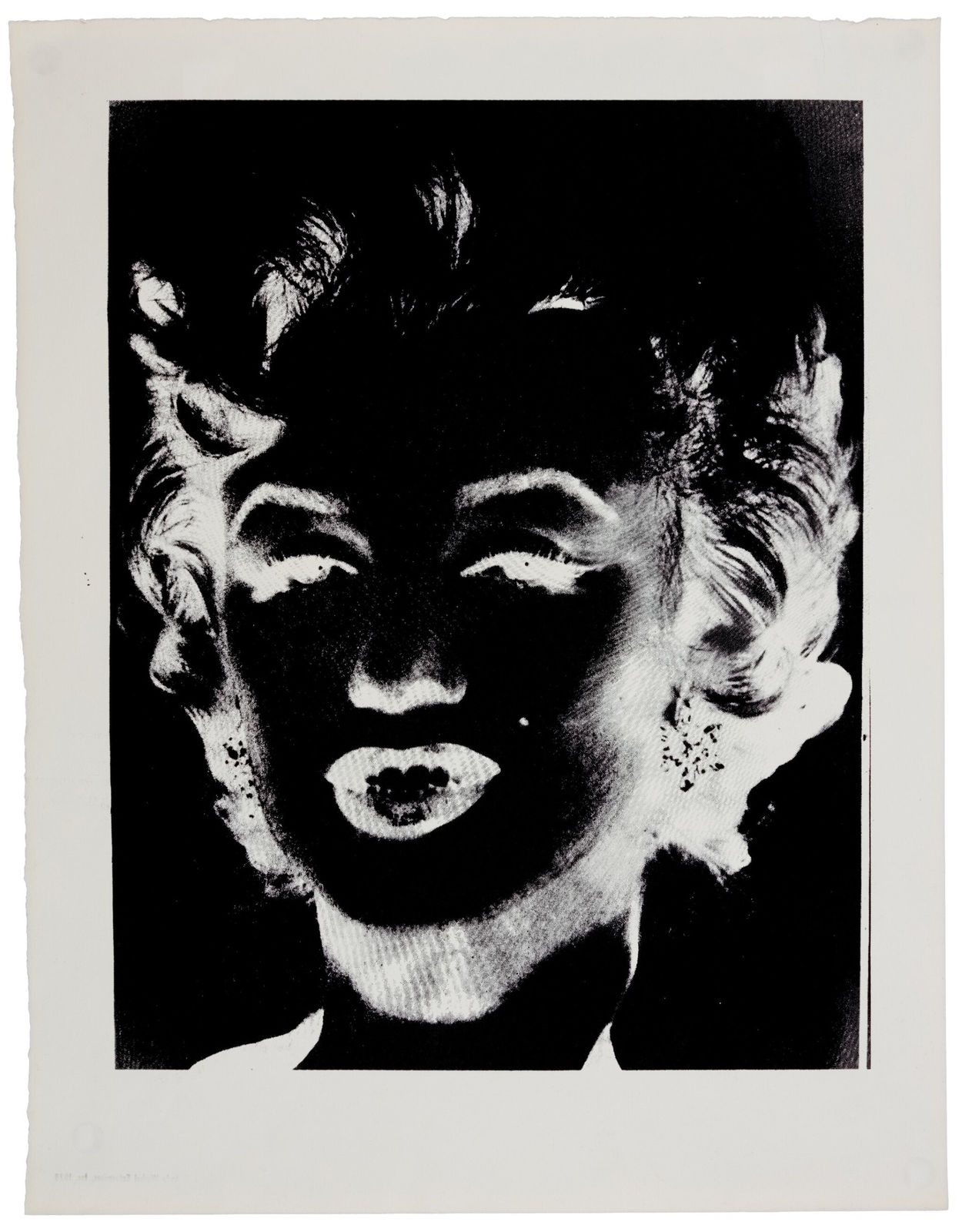
Marilyn Monroe (Marilyn) Reversal (F & S III.3), circa 1978
Unique silkscreen in black on Curtis Rag paper
56.8 x 44.1 cm
22 1/2 x 17 1/2 in.
22 1/2 x 17 1/2 in.
Unique in this format; from the unpublished Personal Projects
Unsigned; Stamped on verso lower left by Andy Warhol Enterprises, Inc.
Executed circa 1978, Andy Warhol’s Marilyn Monroe (Marilyn) [Reversal] is a unique black silkscreen on Curtis Rag paper from the artist’s unpublished Personal Projects. Catalogued by Feldman and Schellmann as...
Executed circa 1978, Andy Warhol’s Marilyn Monroe (Marilyn) [Reversal] is a unique black silkscreen on Curtis Rag paper from the artist’s unpublished Personal Projects. Catalogued by Feldman and Schellmann as III.A.3, the work is an early example of Warhol’s Reversal process and anticipates the formal Reversals series he began in 1979. Unlike his editioned print portfolios, this impression was produced outside a conventional commercial edition and is unique in its format.
Marilyn Monroe’s face is rendered through an inversion of light and shadow, recalling the appearance of a photographic negative. Printed entirely in black, the image emerges through the contrast between the silkscreen ink and the exposed paper. Her eyes, lips and carefully styled hair remain immediately recognisable, yet the absence of Warhol’s familiar bright colours gives the portrait a more spectral quality. The work is unsigned but bears the Andy Warhol Enterprises, Inc. stamp on the reverse, lower left.
Warhol first portrayed Monroe shortly after her death in 1962, using a publicity photograph made for the 1953 film Niagara. He returned to the same image in his celebrated 1967 print portfolio and again during the late 1970s, when he began reconsidering subjects closely associated with his earlier career. By reversing the tonal values of the photograph, Warhol transformed an established Pop Art image into a meditation on reproduction, memory and the persistence of celebrity after death.
Created alongside the development of Warhol’s Shadows paintings of 1978–79, the present work occupies an important transitional position within his practice. Its unique status, unpublished origin and direct relationship to the later Reversals distinguish it from Warhol’s commercially issued Marilyn editions. At the same time, its familiar subject and monochromatic palette make it relevant to collectors of Pop Art, photography-based work and twentieth-century cultural imagery. A detailed condition report is available upon request.
Marilyn Monroe’s face is rendered through an inversion of light and shadow, recalling the appearance of a photographic negative. Printed entirely in black, the image emerges through the contrast between the silkscreen ink and the exposed paper. Her eyes, lips and carefully styled hair remain immediately recognisable, yet the absence of Warhol’s familiar bright colours gives the portrait a more spectral quality. The work is unsigned but bears the Andy Warhol Enterprises, Inc. stamp on the reverse, lower left.
Warhol first portrayed Monroe shortly after her death in 1962, using a publicity photograph made for the 1953 film Niagara. He returned to the same image in his celebrated 1967 print portfolio and again during the late 1970s, when he began reconsidering subjects closely associated with his earlier career. By reversing the tonal values of the photograph, Warhol transformed an established Pop Art image into a meditation on reproduction, memory and the persistence of celebrity after death.
Created alongside the development of Warhol’s Shadows paintings of 1978–79, the present work occupies an important transitional position within his practice. Its unique status, unpublished origin and direct relationship to the later Reversals distinguish it from Warhol’s commercially issued Marilyn editions. At the same time, its familiar subject and monochromatic palette make it relevant to collectors of Pop Art, photography-based work and twentieth-century cultural imagery. A detailed condition report is available upon request.
Provenance
The Andy Warhol FoundationWooster Projects, New York
Leskovar Fine Art, Vienna
Literature
Frayda Feldman and Jorg Schellmann, Andy Warhol Prints, A Catalog Raisonee 1962-1987, New York, 2003, no. III.A.3. p. 230 (another impression illustrated).Publications
Frayda Feldman, and Jörg Schellmann. "Andy Warhol Prints: a Catalogue Raisonne 1962-1987." (2003).アンディパエディションメーリングリストに登録する
* denotes required fields
We will process the personal data you have supplied to communicate with you in accordance with our Privacy Policy. You can unsubscribe or change your preferences at any time by clicking the link in our emails.