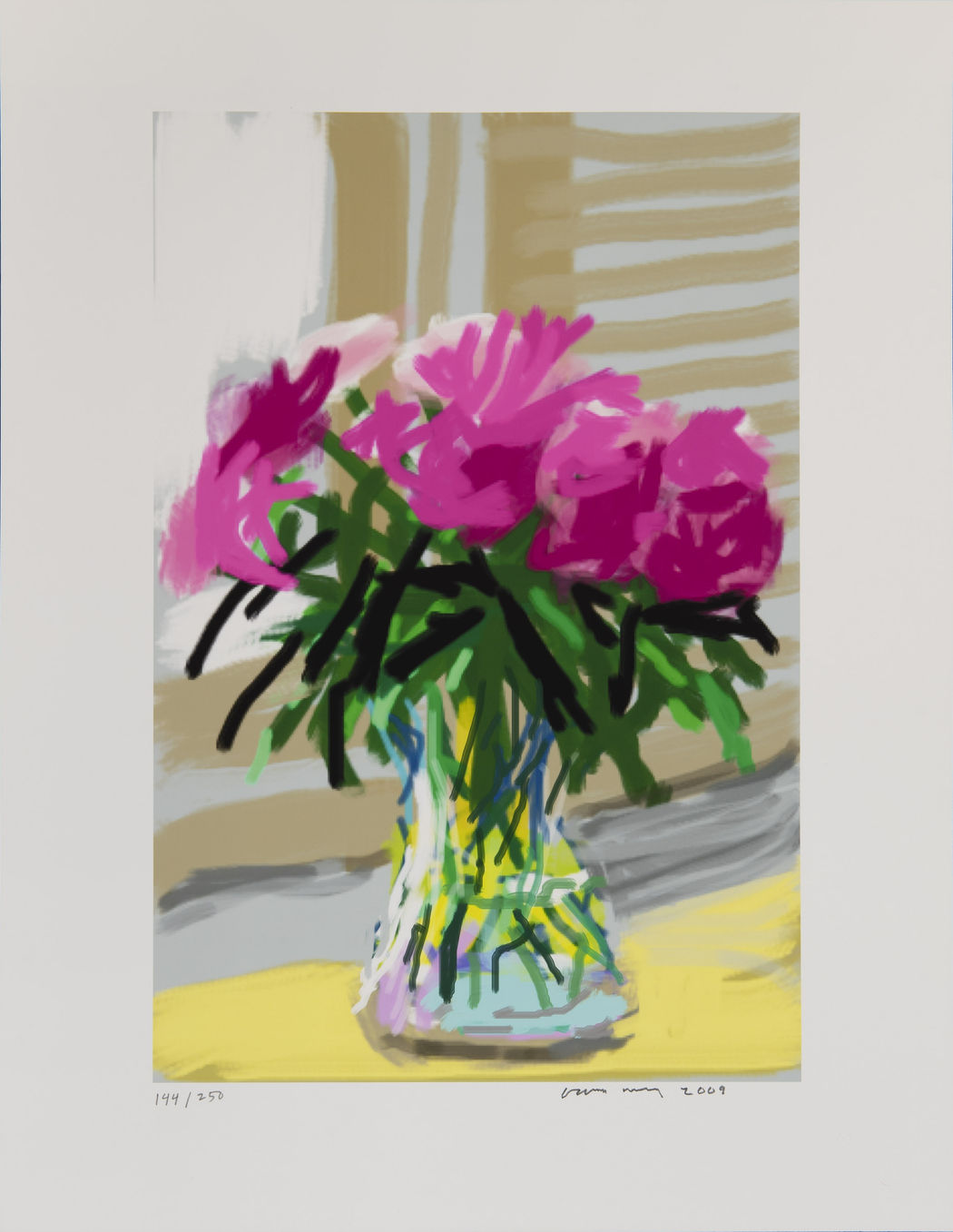
David Hockney's 'Untitled 535'
Nature as Inspiration in Modern and Contemporary Art
Nature, in all its shifting beauty and complexity, has long been a source of fascination for artists. From the curve of a petal to the endless horizon of a Yorkshire field, it offers both subject and metaphor. Within the world of contemporary and modern art, few artists have explored this relationship with the same breadth and intensity as David Hockney and Damien Hirst, alongside other figures sold and collected by Andipa who have each, in their own way, transformed nature into art that is both deeply personal and universally resonant.
David Hockney and the Living Landscape
David Hockney has always looked at the world with a kind of fearless joy, and nowhere is that more evident than in the way he paints nature. His landscapes are not quiet, polite postcard views - they’re alive, brimming with colour and movement. In his Yorkshire paintings, the greens are impossibly green, the skies pulse with shifting blues, and every hedge and winding lane seems to breathe. Hockney returns again and again to the same countryside scenes, not to pin down a single “perfect” moment, but to watch them change, to see how light, shadow, and season rewrite the story each day. His celebrated Woldgate Woods series is a masterclass in this devotion: a familiar stretch of woodland transformed through the colours of spring, summer, autumn, and winter. Whether with paintbrush or iPad, Hockney captures the vibrancy of the British landscape in a way that feels immediate, joyous, and profoundly human.
Yayoi Kusama and the Flower as Icon
Yayoi Kusama’s Flower A offers a very different encounter with nature in contemporary art. This is not a botanical study or a still life, it’s the idea of a flower distilled into something bold, graphic, and unmistakably hers. Kusama’s work is known for its repetition, vivid colour, and hypnotic organic forms, and here the flower becomes a pop icon. Flat petals radiate energy, their shapes and hues commanding the viewer’s attention. Unlike the fragile blooms of the real world, Kusama’s flower is eternal, a statement piece in itself. It bridges the gap between nature and abstraction, reimagining the floral motif in a way that speaks both to her personal universe and to the long tradition of flowers in art.
Damien Hirst: Butterflies, Blossoms, and Impermanence
Damien Hirst’s relationship with natural imagery has produced two very different yet equally compelling series: his butterfly works and his Cherry Blossom paintings. The butterfly pieces are visually dazzling, composed of real, iridescent wings arranged in symmetrical, almost sacred patterns. They celebrate nature’s perfection while confronting its fragility, the brief life of a butterfly suspended forever in an artwork. These pieces are at once beautiful and unsettling, inviting reflection on the tension between preservation and loss. In contrast, Hirst’s Cherry Blossom paintings are explosions of life and colour. Vast canvases are layered with thick, textured paint in pinks, whites, and greens, conjuring the overwhelming abundance of trees in full bloom. The experience is immersive, like standing under a canopy of petals at their absolute peak. These paintings radiate joy, but there’s an underlying poignancy too, cherry blossoms are famously fleeting, and Hirst captures them at the moment before they disappear. It’s a romantic, almost celebratory vision of nature that still echoes his ongoing fascination with beauty, impermanence, and time.
Andy Warhol and Flowers in Pop Art
Andy Warhol’s Flowers approach the natural world through the cool lens of Pop Art. Based on a photograph of hibiscus blooms, the images are flattened, cropped, and silkscreened in blocks of vivid colour. Warhol’s process, repeating the flowers in endless variations, strips away their natural detail and transforms them into icons, as recognisable as his Marilyn Monroe portraits or Campbell’s Soup cans. Here, the flower becomes a symbol, endlessly reproducible, its beauty frozen and commodified. Yet despite this industrial treatment, the Flowers remain compelling: their simplicity of form and bold colour palettes give them a timeless visual appeal.
Seen together, these artists’ interpretations of flowers, landscapes, and other natural subjects offer a rich spectrum of meaning. Hockney’s landscapes immerse us in the changing seasons of Yorkshire, full of light and movement. Kusama transforms the idea of a flower into a bold, almost mythic emblem. Hirst shifts between the delicately preserved beauty of butterflies and the painterly exuberance of cherry blossoms. Warhol reframes the flower as a modern icon, a motif endlessly reimagined through colour and repetition.
The enduring appeal of natural imagery in modern and contemporary art lies in its universality. Nature speaks to us in ways that transcend language, a blossom can evoke love, joy, fragility, or nostalgia, while a landscape can conjure belonging, memory, or discovery. For collectors, artworks grounded in nature bring an elemental connection into a living space, whether through the intimate detail of a Hockney tree, the pop energy of a Kusama bloom, the tactile richness of a Hirst blossom, or the graphic punch of a Warhol flower. Within the Andipa Editions collection, these works don’t simply sit side by side, they have conversations. A Hockney landscape can echo the seasonal joy of Hirst’s cherry blossoms. Kusama’s Flower A can challenge the eye after the cool precision of a Warhol print. The preserved wings of Hirst’s butterflies might feel like the distilled memory of a summer day glimpsed in a Hockney hedgerow. Each piece reframes nature, inviting the viewer to see it in a new way.
Summer in Full Colour runs at Andipa until 30 August 2025. If you would like to buy or sell a print or original painting by David Hockney, Damien Hirst, Andy Warhol or Yayoi Kusama, please contact sales@andipa.com or +44 20 7581 1244
