 Viewers Looking at Ready-made with Skull and Mirrors by David Hockney
 Viewers Looking at Ready-made with Skull and Mirrors by David Hockney
David Hockney
Viewers Looking at Ready-made with Skull and Mirrors, 2018
Photographic drawing print on paper, mounted on dibond
72 x 121 cm
28 ½ x 47 ½ in.
28 ½ x 47 ½ in.
Edition of 25
Signed, dated & numbered in black ink (lower margin)
Excellent Condtion
Framed
Excellent Condtion
Framed


Created in 2018, Viewers Looking at a Ready-made with Skull and Mirrors belongs to David Hockney’s late body of photographic drawings, through which he reconsidered how photography might represent space,...
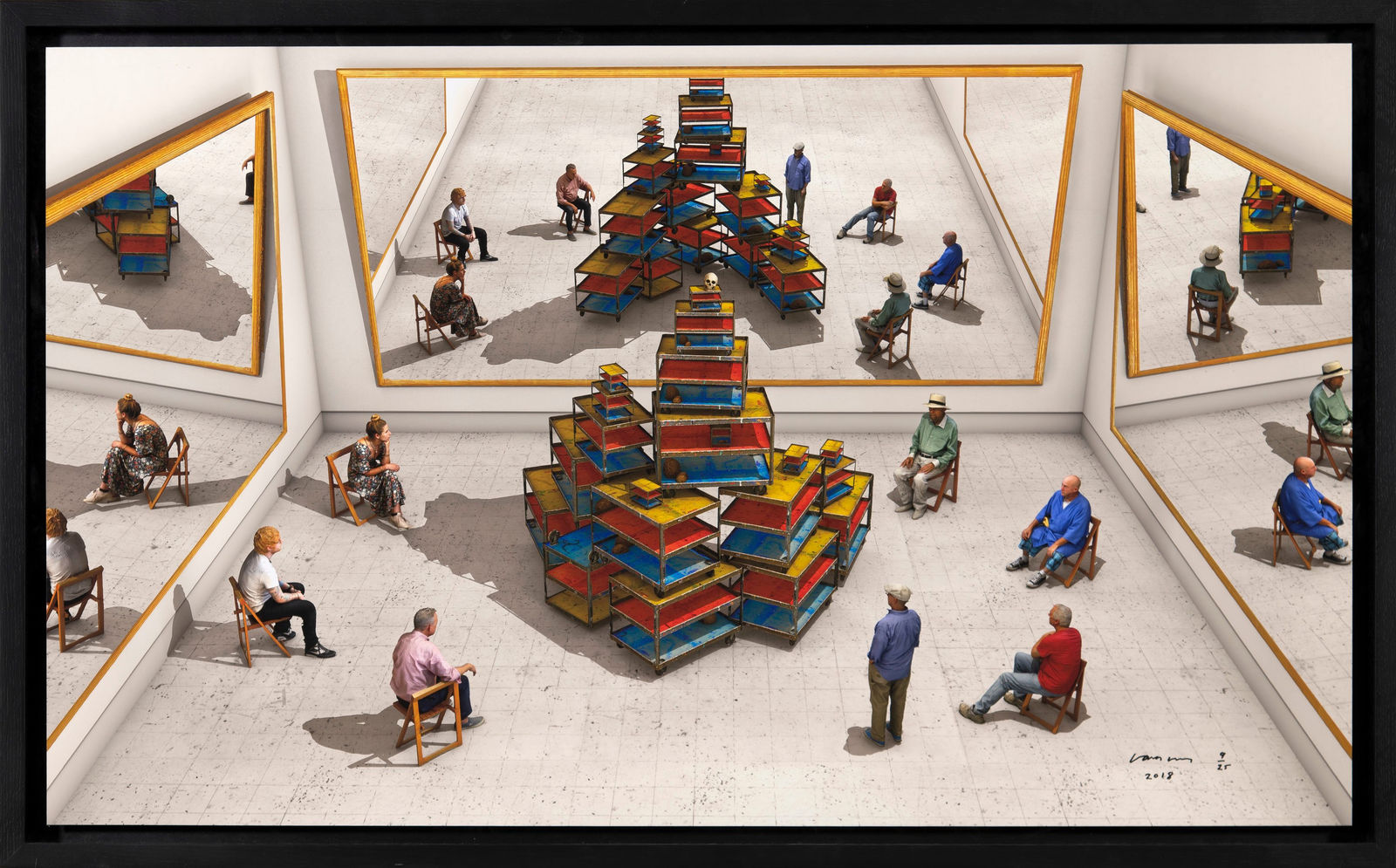
Created in 2018, Viewers Looking at a Ready-made with Skull and Mirrors belongs to David Hockney’s late body of photographic drawings, through which he reconsidered how photography might represent space, time and human vision. Rejecting the fixed viewpoint of a conventional photograph, Hockney assembled numerous images into a digitally constructed scene that records its subjects from subtly differing positions.
The composition presents a white gallery interior occupied by a group of standing and seated figures. They gather around a sculptural assemblage of stacked metal carts surmounted by a skull, while three large mirrors multiply and disrupt their reflections. Shifts in scale, perspective and alignment make the room appear simultaneously coherent and unstable, requiring the viewer’s eye to move continuously between its overlapping spatial zones.
Hockney had questioned the limitations of single-point perspective throughout his career, notably in his composite Polaroids and photographic collages of the 1980s. His later photographic drawings extended this investigation through digital technology. Individual figures and objects could be photographed separately and from multiple angles before being combined, allowing Hockney to construct an image closer to the mobile and cumulative nature of human observation than to the instantaneous vision of a single camera lens.
The work is also reflexive in subject: the depicted spectators look at art while themselves becoming objects of scrutiny. Mirrors further complicate the distinction between viewer, artwork and exhibition space, while the ready-made invokes the twentieth-century challenge to conventional definitions of artistic creation. Published by the artist in an edition of 25, this photographic drawing demonstrates Hockney’s sustained effort to reconcile technological innovation with fundamental questions of perception and representation. A detailed condition report is available upon request.
The composition presents a white gallery interior occupied by a group of standing and seated figures. They gather around a sculptural assemblage of stacked metal carts surmounted by a skull, while three large mirrors multiply and disrupt their reflections. Shifts in scale, perspective and alignment make the room appear simultaneously coherent and unstable, requiring the viewer’s eye to move continuously between its overlapping spatial zones.
Hockney had questioned the limitations of single-point perspective throughout his career, notably in his composite Polaroids and photographic collages of the 1980s. His later photographic drawings extended this investigation through digital technology. Individual figures and objects could be photographed separately and from multiple angles before being combined, allowing Hockney to construct an image closer to the mobile and cumulative nature of human observation than to the instantaneous vision of a single camera lens.
The work is also reflexive in subject: the depicted spectators look at art while themselves becoming objects of scrutiny. Mirrors further complicate the distinction between viewer, artwork and exhibition space, while the ready-made invokes the twentieth-century challenge to conventional definitions of artistic creation. Published by the artist in an edition of 25, this photographic drawing demonstrates Hockney’s sustained effort to reconcile technological innovation with fundamental questions of perception and representation. A detailed condition report is available upon request.
Provenance
Private collection, UKJoin our mailing list
* denotes required fields
We will process the personal data you have supplied to communicate with you in accordance with our Privacy Policy. You can unsubscribe or change your preferences at any time by clicking the link in our emails.