
There is something rather wonderful about the way Henri Matisse could capture a person's character with just a few lines. What might appear effortless was, in fact, the result of years spent studying the human face, understanding its expressions and knowing precisely what could be left out.
His portraits of Nadia Sednaoui, created in 1948, are a lovely example of this. With little more than sweeping black lines and the white of the paper, Matisse produced a series of intimate portraits that feel just as fresh today.
A Familiar Face, Seen Differently
Nadia was introduced to Matisse by his son-in-law, the art critic Georges Duthuit, and began sitting for the artist during the summer of 1948. Matisse was then in his late seventies, having already lived through an extraordinary artistic career. Yet his curiosity had hardly diminished. He continued to explore new ways of seeing, returning to familiar subjects and finding something different in them each time.
Nadia became one of those subjects.
Across a series of drawings and aquatints, Matisse studied her face from different angles, sometimes changing only the slightest detail. A tilt of the head, the shape of an eyebrow or the direction of her gaze could lend an entirely new character to a portrait.
Two Portraits of Nadia
Two particularly interesting examples are Nadia au regard sérieux (1948), recorded as Duthuit 793, and Nadia, Visage de Trois-Quarts (1948), Duthuit 795. Both belong to Matisse's celebrated series of aquatints, yet each has its own personality.
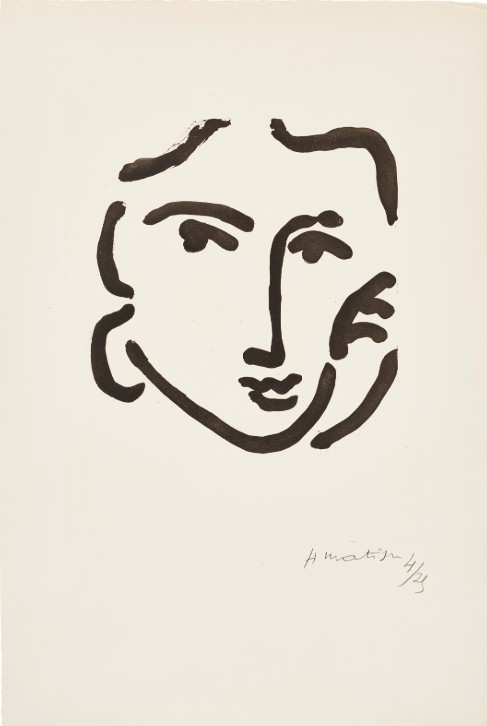
In Nadia au regard sérieux, the emphasis is on the sitter's serious, thoughtful expression. By contrast, Nadia, Visage de Trois-Quarts presents her face at a gentle angle, with bold, flowing lines giving the composition a wonderful sense of movement. What makes these works so appealing is how little Matisse needed to say. There is no elaborate background or unnecessary detail. Every mark has its place, and the areas of untouched paper are every bit as important as the lines themselves. They are wonderfully simple images, although achieving that simplicity was anything but straightforward.
The Art of Knowing When to Stop
By the late 1940s, Matisse had become increasingly interested in reducing his subjects to their essential forms. His use of aquatint was particularly suited to this approach. The technique allowed him to retain the freedom of drawing, preserving the broad, expressive quality of his brushwork while translating it into an original print.
Looking at the portraits today, one gets the impression that each line has been placed almost without hesitation. Yet behind that apparent spontaneity lies a lifetime of observation and refinement.
Perhaps that is what makes these works so enduring. They don't attempt to tell us everything about Nadia. Instead, Matisse leaves just enough for us to recognise a person, an expression and a fleeting moment.
A Portrait at Andipa Editions
We are fortunate to have an original impression of Nadia, Visage de Trois-Quarts (D.795) at Andipa Editions in London. Created in 1948, the work is signed and numbered 9/25 in pencil and was printed by Atelier Lacourière et Frélaut in Paris.
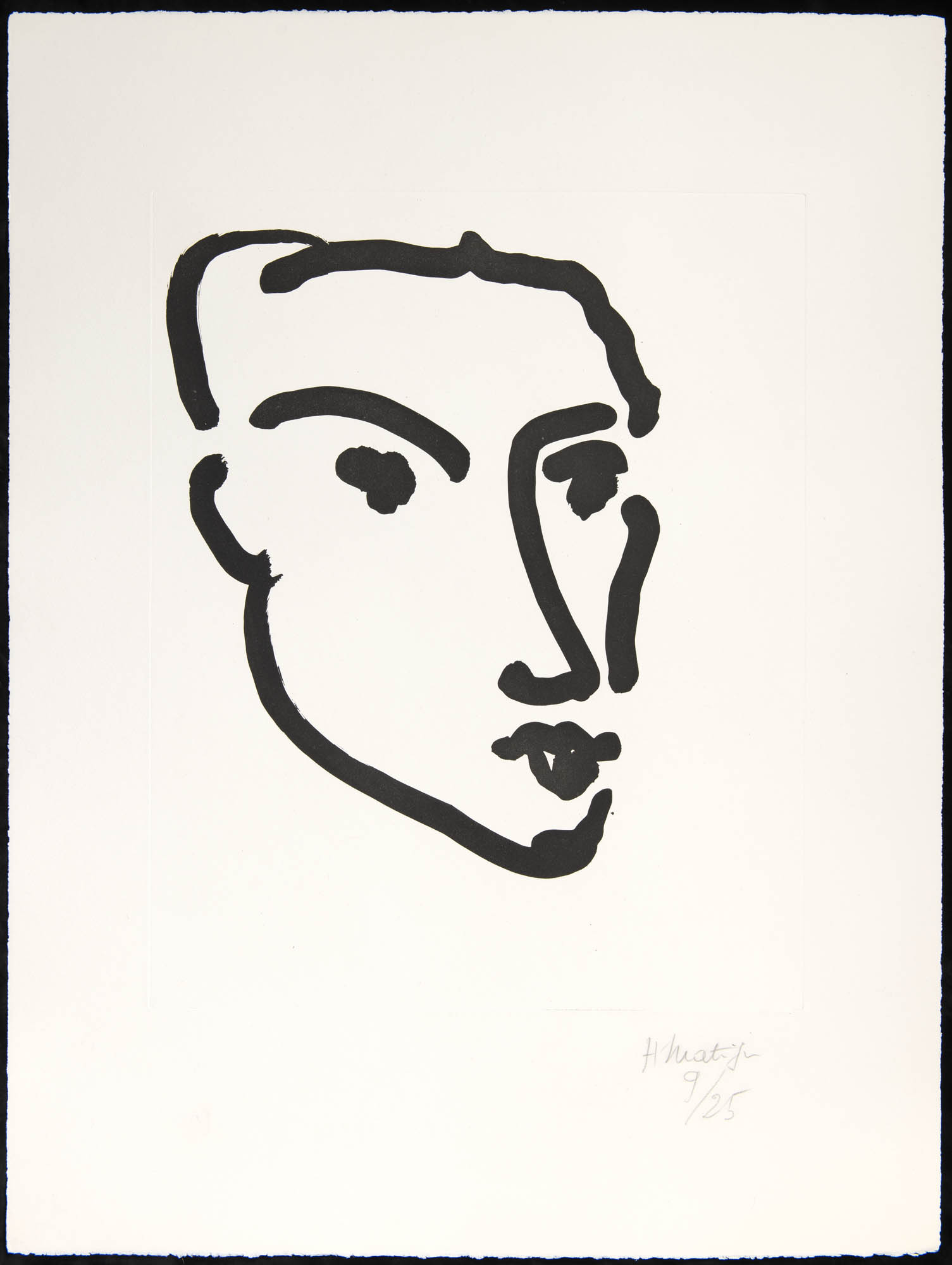
It is a particularly lovely example of Matisse's later work. Nadia's features are conveyed through a small number of confident black lines, while the generous white space gives the portrait an almost effortless elegance. Nearly eighty years on, there is something distinctly modern about it. Perhaps the greatest achievement of these portraits is that, despite their simplicity, they still feel full of life.
Henri Matisse, Nadia, Visage de Trois-Quarts (D.795), 1948, is currently available to view at Andipa Editions, London, subject to prior sale.
