Andy Warhol
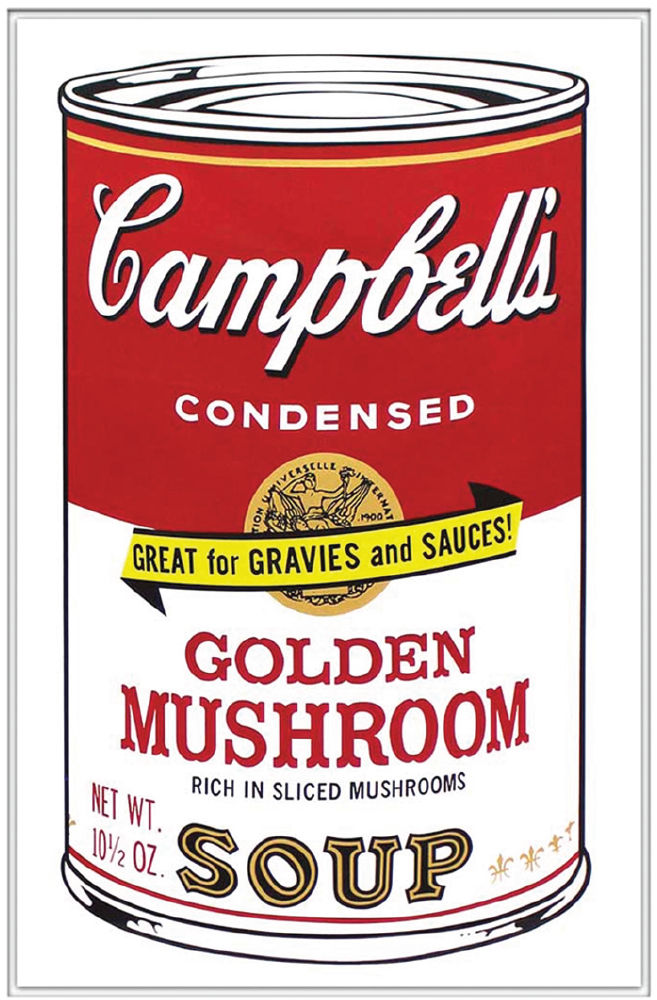
Campbell’s Soup II (F & S II.62) (Golden Mushroom) , 1969
Screenprint on paper
88.9 x 58.42 cm.
35 x 23 in.
35 x 23 in.
Edition of 250 (plus proofs)
Signed in ball-point pen and numbered with a rubber stamp on verso
Edition of 250, plus 25 AP (artist proofs). From the portfolio of ten screenprints from the set Campbell's Soup II. Golden Mushroom is one of ten Campbell’s soup flavours chosen...
Edition of 250, plus 25 AP (artist proofs). From the portfolio of ten screenprints from the set Campbell's Soup II.
Golden Mushroom is one of ten Campbell’s soup flavours chosen by Andy Warhol for his 1969 Campbell’s Soup Cans II series. Created a year after his original soup can portfolio, this series highlights a muse that Warhol repeatedly revisited early in his career. His artistic talent and technical skill are evident in the precision of each print, making them almost indistinguishable from the real thing.
For Warhol, anything could be art, a notion this series embodies. By choosing everyday consumer goods as his subject matter, Warhol blurred the lines between “high” and “low” art, creating works that were accessible to a wide audience. Warhol’s choice of the Campbell’s soup can—a product consumed by people of all socioeconomic backgrounds—underscores his belief in art’s accessibility.
This approach allowed Warhol to break down the elitist barriers of the art world, reclaiming a symbol of everyday American life as a means of creating art that resonated with the general public. By elevating the humble soup can to the level of "high art," Warhol satirised the exclusivity of the art establishment. To him, a piece of art was no different from an everyday commodity like a soup can, challenging traditional notions of artistic value and making art more approachable to all.
Golden Mushroom is one of ten Campbell’s soup flavours chosen by Andy Warhol for his 1969 Campbell’s Soup Cans II series. Created a year after his original soup can portfolio, this series highlights a muse that Warhol repeatedly revisited early in his career. His artistic talent and technical skill are evident in the precision of each print, making them almost indistinguishable from the real thing.
For Warhol, anything could be art, a notion this series embodies. By choosing everyday consumer goods as his subject matter, Warhol blurred the lines between “high” and “low” art, creating works that were accessible to a wide audience. Warhol’s choice of the Campbell’s soup can—a product consumed by people of all socioeconomic backgrounds—underscores his belief in art’s accessibility.
This approach allowed Warhol to break down the elitist barriers of the art world, reclaiming a symbol of everyday American life as a means of creating art that resonated with the general public. By elevating the humble soup can to the level of "high art," Warhol satirised the exclusivity of the art establishment. To him, a piece of art was no different from an everyday commodity like a soup can, challenging traditional notions of artistic value and making art more approachable to all.
Provenance
The Andy Warhol FoundationThaddaeus Ropac Gallery, Salzburg
Leskovar Fine Art, Vienna
Publications
Frayda Feldman, and Jörg Schellmann. "Andy Warhol Prints: a Catalogue Raisonne 1962-1987." (2003)Join Our Mailing List
* denotes required fields
We will process the personal data you have supplied to communicate with you in accordance with our Privacy Policy. You can unsubscribe or change your preferences at any time by clicking the link in our emails.