
Andy Warhol
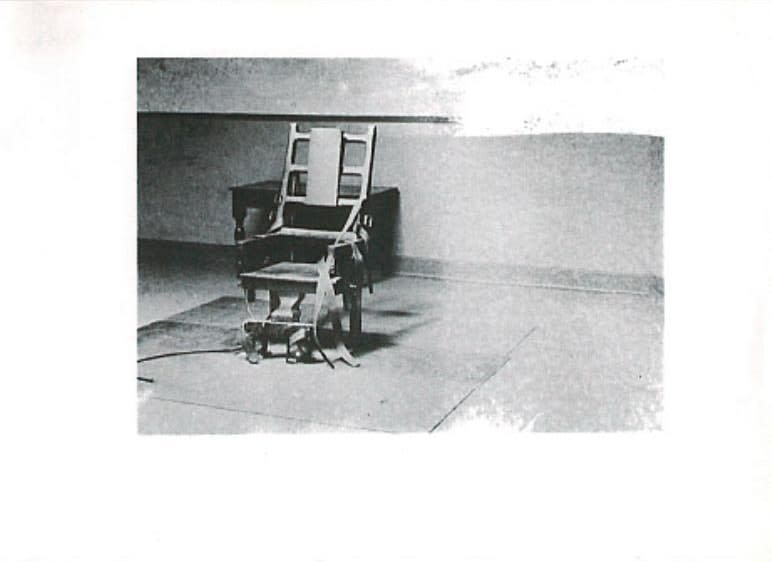
Electric Chair, CA. 1978
Silkscreen on soft white wove paper
45.4 x 60.6 cm.
18 x 24 in.
18 x 24 in.
Unique
Unsigned
Authenticated. Stamped on verso by Andy Warhol Authentication Board "UP 47.49"
Framed
Authenticated. Stamped on verso by Andy Warhol Authentication Board "UP 47.49"
Framed


Andy Warhol’s unique Electric Chair, c. 1978 is a black silkscreen on soft white wove paper, revisiting one of his most haunting motifs from the 1960s “Death and Disaster” works....
Andy Warhol’s unique Electric Chair, c. 1978 is a black silkscreen on soft white wove paper, revisiting one of his most haunting motifs from the 1960s “Death and Disaster” works. Unlike the 1971 Electric Chairs portfolio, this is not part of an edition but a one-off impression, produced as part of his so-called “Retrospective” revisitations of earlier imagery. The familiar empty execution chamber from Sing Sing appears here in stark black and white, stripped of the acid colours of the earlier prints.
In this pared-back form, the image becomes colder and more forensic. The soft white paper reads almost like the page of a report or a newspaper, reinforcing the link between state violence and its mediation through photography and print. The silkscreen process introduces delicate variations in tone and texture, making the room seem at once flatly documented and eerily unstable.
Conceptually, the work stands at a crossroads in Warhol’s career: a late-1970s reflection on a subject that had already become emblematic of his darker, more political edge. Where the 1960s paintings and the 1971 portfolio emphasised repetition and seriality, this single, unique print feels more like an after-image – a sober, almost archival acknowledgement of the electric chair as one of Pop art’s most unsettling icons.
In this pared-back form, the image becomes colder and more forensic. The soft white paper reads almost like the page of a report or a newspaper, reinforcing the link between state violence and its mediation through photography and print. The silkscreen process introduces delicate variations in tone and texture, making the room seem at once flatly documented and eerily unstable.
Conceptually, the work stands at a crossroads in Warhol’s career: a late-1970s reflection on a subject that had already become emblematic of his darker, more political edge. Where the 1960s paintings and the 1971 portfolio emphasised repetition and seriality, this single, unique print feels more like an after-image – a sober, almost archival acknowledgement of the electric chair as one of Pop art’s most unsettling icons.
Join Our Mailing List
* denotes required fields
We will process the personal data you have supplied to communicate with you in accordance with our Privacy Policy. You can unsubscribe or change your preferences at any time by clicking the link in our emails.