Keith Haring’s Life to Be Adapted for Television
The art world is abuzz with news that Keith Haring’s life will soon be brought to television in a major series written and directed by Andrew Haigh. Best known for films such as Weekend, 45 Years, and All of Us Strangers, Haigh is a filmmaker with a gift for intimacy, atmosphere, and emotional resonance. His decision to take on Haring’s story — with the blessing of the Keith Haring Foundation and based on Brad Gooch’s biography Radiant: The Life and Line of Keith Haring — signals that this will not be another glossy artist biopic. It promises instead a portrait of an artist whose energy, activism, and charisma continue to ripple through culture. For collectors, this development carries weight. Whenever an artist’s life is translated onto screen, legacies shift and markets respond. Museums revisit their holdings, new generations of collectors emerge, and long-overlooked areas of an oeuvre can suddenly find themselves in the spotlight. With Haring, the possibilities are vast.
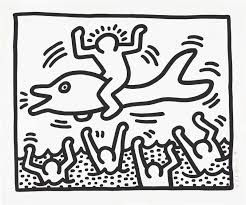
Few artists embody the pulse of the 1980s as vividly as Haring. His chalk drawings on New York’s subway walls turned the everyday commute into an exhibition space, transforming a democratic public arena into a canvas alive with radiant babies, barking dogs, and writhing lines. What looked at first like playful graffiti soon revealed itself as a sophisticated visual language — part cartoon, part hieroglyph, part manifesto. Haring was not only painting; he was broadcasting. His work fused joy with urgency, the immediacy of pop with the weight of activism.
What makes the timing of this series particularly resonant is the way Haring’s concerns feel newly relevant. In an age of social activism, renewed struggles for LGBTQ+ rights, and questions about art’s accessibility, Haring’s example of marrying bold aesthetics with moral conviction speaks directly to the present. Collectors today are increasingly drawn to artists who combine visual impact with cultural engagement. Haring offers both, in a language that is as instantly legible today as it was forty years ago.
Subway Years, Pop Shop, and East Village Scene
Haigh is a fascinating choice to tell this story. Unlike directors who might lean into spectacle or myth, Haigh has built his career on emotional truth and subtlety. His films tend to linger in silences, exploring the inner landscapes of characters. That sensibility could open new dimensions of Haring, moving beyond the clichés of “radiant baby” and “AIDS activist” to show a complex man: joyful, political, vulnerable, ambitious. For collectors, a nuanced portrayal matters. It deepens the narrative context surrounding works, which in turn influences both cultural and market value. A screen story that emphasises Haring’s democratic ethos, for instance, might prompt a re-evaluation of his multiples, posters, and Pop Shop pieces — areas long considered secondary to his paintings but increasingly seen as central to his vision of art for all.
Although details of the series are still under wraps, certain arcs are almost inevitable. We can expect to see Haring’s subway years, where chalk drawings became legend, his immersion in the East Village scene alongside Jean-Michel Basquiat and Madonna, his radical embrace of retail through the Pop Shop, and his extraordinary productivity in the face of his AIDS diagnosis. Each of these chapters carries implications for collectors. Subway works and photographs documenting them may receive fresh attention. Ephemera and activist materials, often overlooked, could gain scholarly and institutional prestige. Even commercial ventures like the Pop Shop — long divisive — may be reinterpreted as visionary acts of accessibility.
Market and Legacy Impacts for Haring’s Work
The consequences of a major screen portrayal are never confined to storytelling. They ripple outward into museums, markets, and public discourse. When millions of viewers encounter Haring’s life afresh, awareness grows, demand rises, and values shift. Institutions respond with exhibitions and publications, reinforcing both market and cultural relevance. And new generations, many of whom know Haring’s imagery but little of his biography, discover not only the work but the life that made it urgent. For collectors, this means a potential recalibration of the canon. Works associated with particular moments highlighted in the series may find themselves newly coveted, while areas once seen as peripheral could be pulled into the centre.
There are, of course, risks. Any retelling of an artist’s life walks a fine line between authenticity and simplification. To flatten Haring into a saintly activist or tragic martyr would do a disservice to his contradictions, his humour, and his complexities. Overemphasis on his most famous icons could reduce him to cliché. And yet, with Haigh’s hand on the wheel, there is hope for something richer — a portrait that does not shy away from contradictions, that honours both the spectacle and the silences, and that reminds us why Haring mattered, and still matters.
For those who already hold Haring works, the series may bring renewed attention and reappraisal. For those considering acquisitions, this could be a moment to look toward areas of his output still undervalued: the posters and multiples created for activist causes, the photographs of subway drawings, the objects of the Pop Shop. For institutions, it is a chance to frame Haring not only as a pop phenomenon but as a cultural voice whose activism was as central as his line.
Reimagining Keith Haring’s Legacy Through Film
Ultimately, what makes this development exciting is not only what it may mean for markets, but for legacy. Keith Haring died in 1990 at just 31, leaving behind a body of work that still feels startlingly fresh. His imagery is everywhere, yet the man behind it is less often understood. Haigh’s series, if it succeeds, will not only reignite interest in his art but reintroduce him as a figure of cultural conscience, joy, and vulnerability. For collectors, that reframing is crucial. It enriches the meaning of ownership, deepens the story a work can tell, and underscores why Haring remains one of the most compelling artists to collect today. In the end, Haring’s life was short, but it was incandescent. To see it told by a filmmaker of Haigh’s sensitivity promises more than a biopic. It offers a chance to reimagine what his art means now: not only lines on a wall, but a radiant legacy that continues to move markets, shape culture, and inspire collectors across the world.
For further information, visit:
https://news.artnet.com/art-world/keith-haring-biopic-2688689
https://deadline.com/2025/08/andrew-haigh-keith-haring-tv-series-working-title-1236492358/
https://www.harpersbazaar.com/culture/film-tv/a65889122/keith-haring-life-tv-series-news-cast-spoilers-date/
