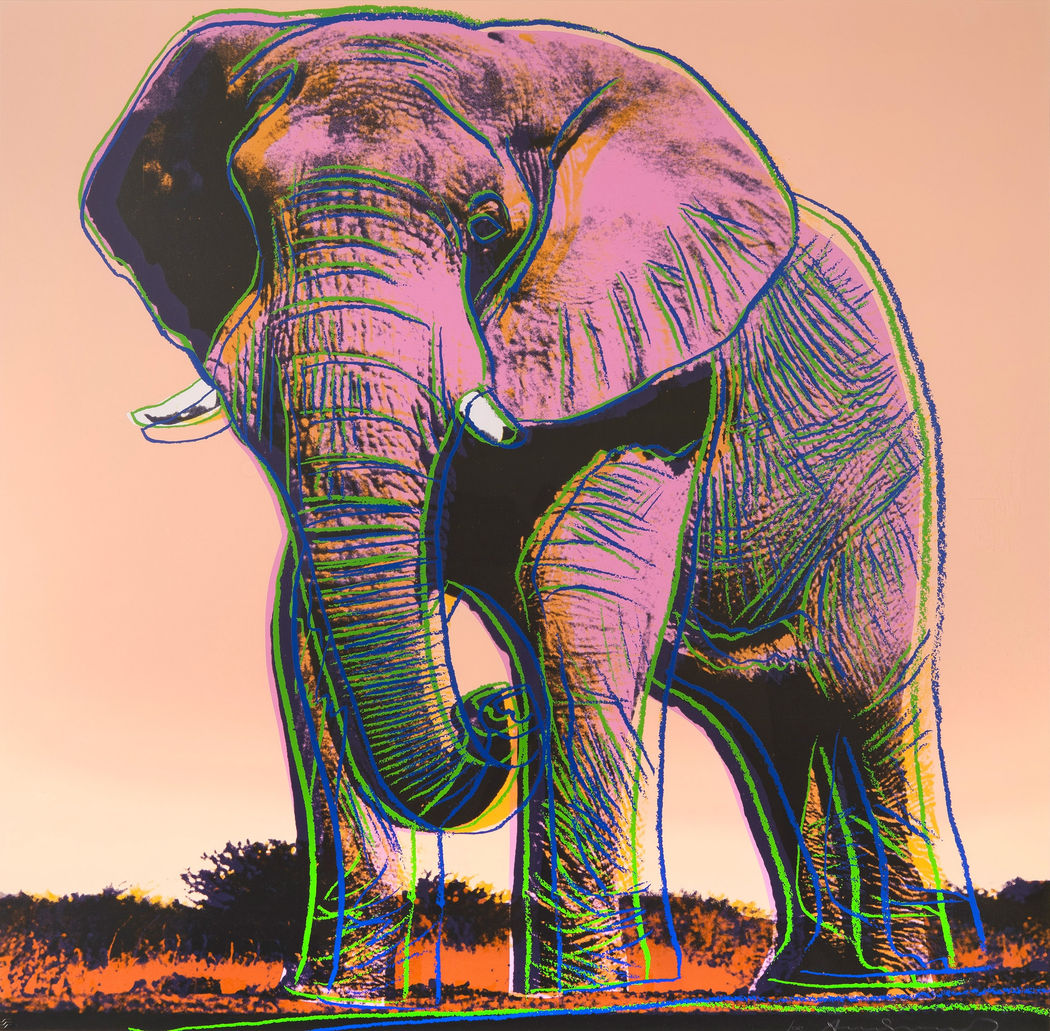
Andy Warhol, African Elephant from Endangered Species series
Andy Warhol: Beyond Glamour and Celebrity
For many, Andy Warhol represents celebrity, glamour, and the surface sheen of modern life — Marilyn, soup cans, electric chairs, dollar signs. Yet beneath the gloss and glimmer of his Pop persona, Warhol harboured a quiet but profound connection with animals, one that manifested subtly through his art and more overtly in his personal choices. His fascination with the natural world — from his beloved cats and dachshunds to his celebrated Endangered Species series — reveals a surprisingly compassionate dimension of an artist so often misunderstood as detached or mechanical.
Early Awareness of Animal Welfare and Environmental Issues
At a time when conversations about animal welfare and environmental preservation were only beginning to enter mainstream consciousness, Warhol’s work showed a deep awareness of the fragility of life — human and non-human alike. His artistic engagement with animals wasn’t born from sentimentalism but from an acute understanding of image, value, and fame. Warhol knew that visibility was power, and in immortalising animals through his unmistakable style, he gave them a form of celebrity that few others could have achieved.
The Endangered Species Portfolio
In 1983, working with New York gallerist Ronald Feldman, Warhol created his now-iconic Endangered Species portfolio — a collection of ten screenprints depicting animals facing extinction, including the African Elephant, the Siberian Tiger, the Giant Panda, and the Bald Eagle. Using his signature palette of saturated colours and bold outlines, Warhol transformed creatures of crisis into icons of contemporary culture. Feldman had suggested the theme after conversations about ecology and human responsibility, and Warhol’s immediate response was characteristically poignant: “I love animals. I have a dog named Archie.”
That comment, at once simple and sincere, reflects the duality of Warhol’s persona. Beneath the detached mask of his public image was someone who loved the companionship of animals and recognised the tragedy of their disappearance. His Endangered Species were not decorative — they were deliberate. Each print turned an overlooked ecological statistic into a symbol of beauty, celebrity, and loss. By framing these animals as “the new stars,” Warhol blurred the boundaries between fame and survival: he understood that in the modern world, what people cared about most were faces, brands, and icons. If an image could sell perfume, soup, or silver wigs, perhaps it could also save a tiger.
Emotional Resonance and Human Connection
Collectors often speak of the Endangered Species series as one of Warhol’s most emotionally resonant bodies of work. Its appeal extends beyond art history into something more human — a reflection of our shared responsibility. Unlike his portraits of Marilyn Monroe or Mick Jagger, which explore the ephemerality of fame, these works celebrate life itself. Their brilliance lies in their paradox: bright, almost cheerful surfaces that mask a deep melancholy beneath. Warhol, as ever, understood the power of contradiction.
For Andipa collectors, Warhol’s animal works occupy a unique position in his oeuvre. They carry the unmistakable visual language of Pop Art — repetition, flat colour, commercial scale — yet they are infused with sincerity. This is Warhol at his most introspective. He was, after all, a deeply private man who surrounded himself with pets. His studio, The Factory, was famously chaotic, but at home he preferred the company of his cats and his two dachshunds, Archie and Amos. He once remarked that the dogs were like extensions of himself, often bringing Archie along to interviews and public events. In photographs from the period, Warhol’s gentle affection for them is evident — a rare glimpse behind the mask of detachment.
Commentary on Consumption and Modern Life
Warhol’s relationship with animals extended into his attitudes toward consumption and lifestyle. Though not strictly vegetarian, he was acutely aware of modern society’s commodification of nature — an awareness that surfaces throughout his work. His Cow Wallpaper (1966) transformed the humble animal into a pattern of absurd abundance, challenging viewers to consider how mass production reduces living beings to decorative motifs. Even his seemingly playful Fish drawings and Cats Named Sam book (produced with his mother, Julia Warhola) hint at a recurring fascination: the beauty and individuality of creatures often overlooked.
In the context of today’s art world — and in conversations among Andipa’s collectors — Warhol’s environmental and animal themes feel more relevant than ever. The Endangered Species series has grown in significance not only for its aesthetic brilliance but for its prescience. Created more than forty years ago, it anticipated many of the conversations that now dominate global consciousness: the climate crisis, habitat loss, and the ethical implications of human consumption. Warhol, in his uniquely quiet way, was already there — turning the planet’s most vulnerable inhabitants into the stars of his canvas.
For collectors, acquiring one of Warhol’s animal-themed works is not merely an investment in art history but a gesture of empathy and awareness. It’s an acknowledgment that the same artist who gave us Marilyn and Mao also gave us the Bald Eagle and the African Elephant — with equal reverence. Each print acts as a bridge between Pop and purpose, a celebration of life that reminds us of art’s power to illuminate issues often left in the shadows.
At Andipa, Warhol’s works continue to inspire dialogue not only about collecting but about care — care for art, for legacy, and for the world we inhabit. Whether one stands before a shimmering Endangered Species silkscreen or a playful drawing of a cat, the through-line is the same: Warhol’s ability to make us look again, to see beauty where we least expect it, and to confront, however gently, what we risk losing.
Warhol once said, “I think having land and not ruining it is the most beautiful art that anybody could ever want.” In that statement lies the essence of his silent activism — not loud, not didactic, but profoundly human. For collectors and admirers alike, engaging with his animal works is a way to connect with that quieter Warhol: the man who saw art not just in the glamour of people but in the dignity of all living things.
In an age defined by spectacle, Warhol used his own tools of fame and repetition to whisper a message of care. And decades later, his animals still speak — in colour, in courage, and in compassion.
