Andy Warhol did not simply paint soup cans and movie stars. He transformed the visual language of modern culture. By repeating familiar images until they became both glamorous and unsettling, Warhol captured the rhythm of mass media long before social media feeds, viral memes, and celebrity branding dominated daily life. His work blurred the boundaries between fine art, advertising, commerce, and entertainment in ways that still shape contemporary culture today.
More than half a century after the rise of Pop Art, Warhol’s influence remains remarkably current. Younger collectors continue to gravitate toward bold pop imagery, street art, and editioned works because these forms feel accessible, culturally fluent, and emotionally immediate. The path from Warhol’s silk-screened Marilyns to Banksy’s politically charged stencils is not a straight line, but it is unmistakably connected.
Repetition as a Cultural Mirror
Before Warhol, fine art was largely built on ideals of originality and singular artistic genius, a tradition theorised through thinkers such as Walter Benjamin and his concept of the “aura” of unique artworks. Warhol disrupted this framework by embracing repetition as both method and message.
His repeated portraits of Marilyn Monroe, Elvis Presley, and Elizabeth Taylor mimicked the endless circulation of celebrity images through newspapers, television, magazines, and advertising. He understood that modern fame depended on visibility rather than intimacy and that celebrities had become ‘products’ consumed at scale and reproduced endlessly until their identities were flattened into symbols. A portrait of Marilyn Monroe was no longer only about Marilyn herself; it was about the industrial production of beauty, desire, tragedy, and public obsession.
This was revolutionary because Warhol refused to moralise. Rather than openly condemning consumer culture, he mirrored it back to audiences with eerie precision. Campbell’s soup cans looked familiar because they were familiar. Brillo boxes resembled supermarket packaging because that was the point. Warhol transformed commercial imagery into high art without changing its visual language.
And in doing so, he questioned what art actually was: could a mass-produced image still possess emotional power? Could repetition itself become meaningful? Could commercial aesthetics hold the same cultural weight as traditional painting?
The answer, it turned out, was yes.
From Warhol to Banksy
The clearest way to understand Warhol’s continuing relevance is to place his work alongside Banksy’s. Although separated by generation, medium, and tone, both artists recast familiar imagery as a form of cultural diagnosis, using repetition and recognisable symbols to expose how power operates through visibility itself.
Andy Warhol worked within the visual grammar of advertising, Hollywood portraiture, and mass media. His studio, The Factory, functioned as an extension of that logic: a hybrid space where art production became social performance, and where collaboration, delegation, and constant image-making blurred the boundary between artist, assistant, and audience. Authorship was not removed, but deliberately dispersed into a system that resembled cultural manufacturing. In contrast, Banksy draws on graffiti, protest signage, and unsanctioned public intervention, but constructs his practice around anonymity rather than visibility. Where Warhol amplified presence through The Factory, Banksy erases presence through the absence of a confirmed identity. One turns the artist into a brand-like system; the other removes the artist as a brand entirely.
Yet despite these opposing structures of authorship, both rely on extreme accessibility: images that are immediately legible, easily reproduced, and capable of circulating beyond traditional art spaces. In each case, simplicity is not a reduction of meaning but the mechanism that enables cultural scale.
For example, Warhol’s Campbell’s Soup Cans compress consumer capitalism into a single, endlessly repeatable unit. The repetition mimics supermarket shelving and industrial branding, turning commercial packaging into both subject and structure. The effect is not simply to depict consumer culture, but to replicate its logic within the artwork itself.
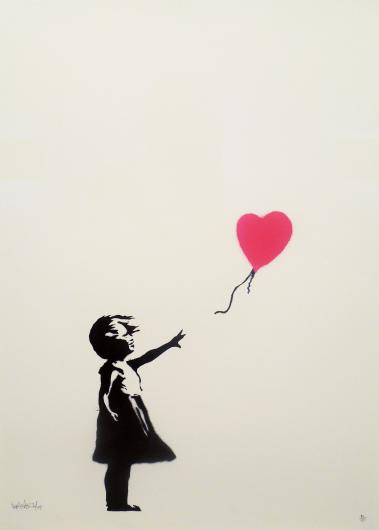
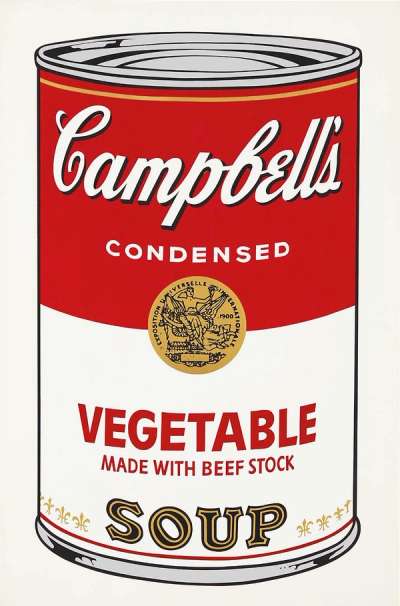
Banksy’s Girl with Balloon, on the other hand, operates in a different register but achieves a comparable level of distilled recognition. The image is stripped to near-symbolic clarity: a child, a drifting heart-shaped balloon, and an emotional ambiguity that can read as loss, hope, or political fragility. Like Warhol’s soup cans, it functions almost as a visual logo—one that circulates easily across walls, prints, screens, and social media, accumulating meaning through repetition rather than narrative complexity.
The divergence between the two artists becomes most apparent in tone. Warhol sustains ambiguity: his soup cans, portraits, and commercial imagery resist fixed interpretation, oscillating between critique and celebration. Banksy, by contrast, tends toward explicit narrative and moral direction. Works such as Love is in the Air, Kids on Guns, and Girl with Balloon articulate clearer positions on war, surveillance, consumerism, and inequality, even when they retain symbolic openness.
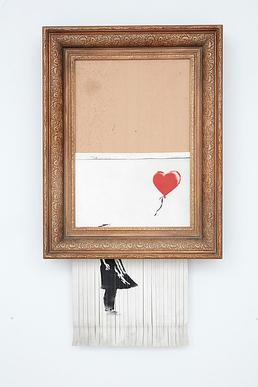
Yet Banksy’s practice also reinforces one of Warhol’s central insights: opposition and commodification are no longer separate forces. The 2018 shredding of Girl with Balloon during auction did not escape the art market’s logic; instead, it intensified it. A gesture framed as anti-commercial intervention was immediately absorbed into global media circulation and auction history, becoming one of the most widely reproduced art moments of the contemporary era. Warhol would likely have recognised this not as a contradiction to his worldview, but as its confirmation.
This convergence is further reinforced through the role of editioned works. Warhol’s adoption of silkscreen printing aligned with his belief that art could operate like media production, multipliable, distributed, and structurally tied to reproduction rather than uniqueness. Banksy’s print editions function similarly, relying on controlled circulation to generate both accessibility and cultural reach. Platforms such as Andipa Editions highlight how both artists are now positioned within systems where reproducibility is not secondary to the artwork but fundamental to its meaning.
In this sense, editions do not dilute artistic value; they amplify visibility. A Warhol print or a Banksy edition does not exist as an isolated object but as part of a dispersed network of images reproduced across domestic interiors, galleries, auction houses, publications, and digital feeds. Meaning emerges not from singular presence but from repeated encounter.
Why Younger Collectors Still Gravitate Toward Pop Imagery
The appeal of Pop Art among younger collectors is closely tied to how contemporary visual culture operates. Bold colours, graphic simplicity, celebrity references, and instantly legible symbols align naturally with a digital environment defined by scrolling, branding, and constant image saturation. Pop Art does not feel distant or academic; it feels structurally familiar, almost native to how images are now consumed.
Unlike more historically complex movements, Pop Art communicates immediately. Works by Andy Warhol or contemporary street practices associated with Banksy can function simultaneously as decoration, cultural commentary, and identity signal. That multi-functionality is key for younger audiences entering a market where art is not only collected but also displayed, shared, and performed socially.
There is also a generational attraction to contradiction. Pop and street art critique consumerism while existing within it, and question celebrity culture while using its visual language. That tension mirrors the conditions of digital life, where self-expression and self-branding are constantly intertwined. Social media intensifies this further: platforms built on repetition, virality, and visual identity echo many of Warhol’s core insights about fame, reproduction, and manufactured visibility.
This is also why editions remain so important. Warhol’s embrace of silkscreen printing helped redefine art as reproducible rather than singular, opening collecting beyond elite exclusivity. Banksy’s print releases follow a similar logic, controlled editions that preserve cultural meaning while widening access. In both cases, reproducibility is not a compromise but part of the work’s logic.
Today, editions extend this democratisation further through online platforms and contemporary print markets, allowing younger collectors to engage directly with major cultural narratives without institutional barriers. As a result, Pop Art is not treated as nostalgia. It functions as a framework for understanding how images, identity, and value operate in the present moment.