Banksy
Bomb Hugger, 2003
Screenprint on paper
70 x 50 cm
27 1/2 x 19 3/4 in.
27 1/2 x 19 3/4 in.
Edition of 150
Signed; numbered in pencil lower right
Excellent condition
Framed
Pest Control COA
Excellent condition
Framed
Pest Control COA
Numbered 134 from the signed edition of 150. A separate unsigned edition of 600 was also published. Published by Pictures on Walls, London. Signed and numbered in pencil lower right....
Numbered 134 from the signed edition of 150. A separate unsigned edition of 600 was also published. Published by Pictures on Walls, London. Signed and numbered in pencil lower right.
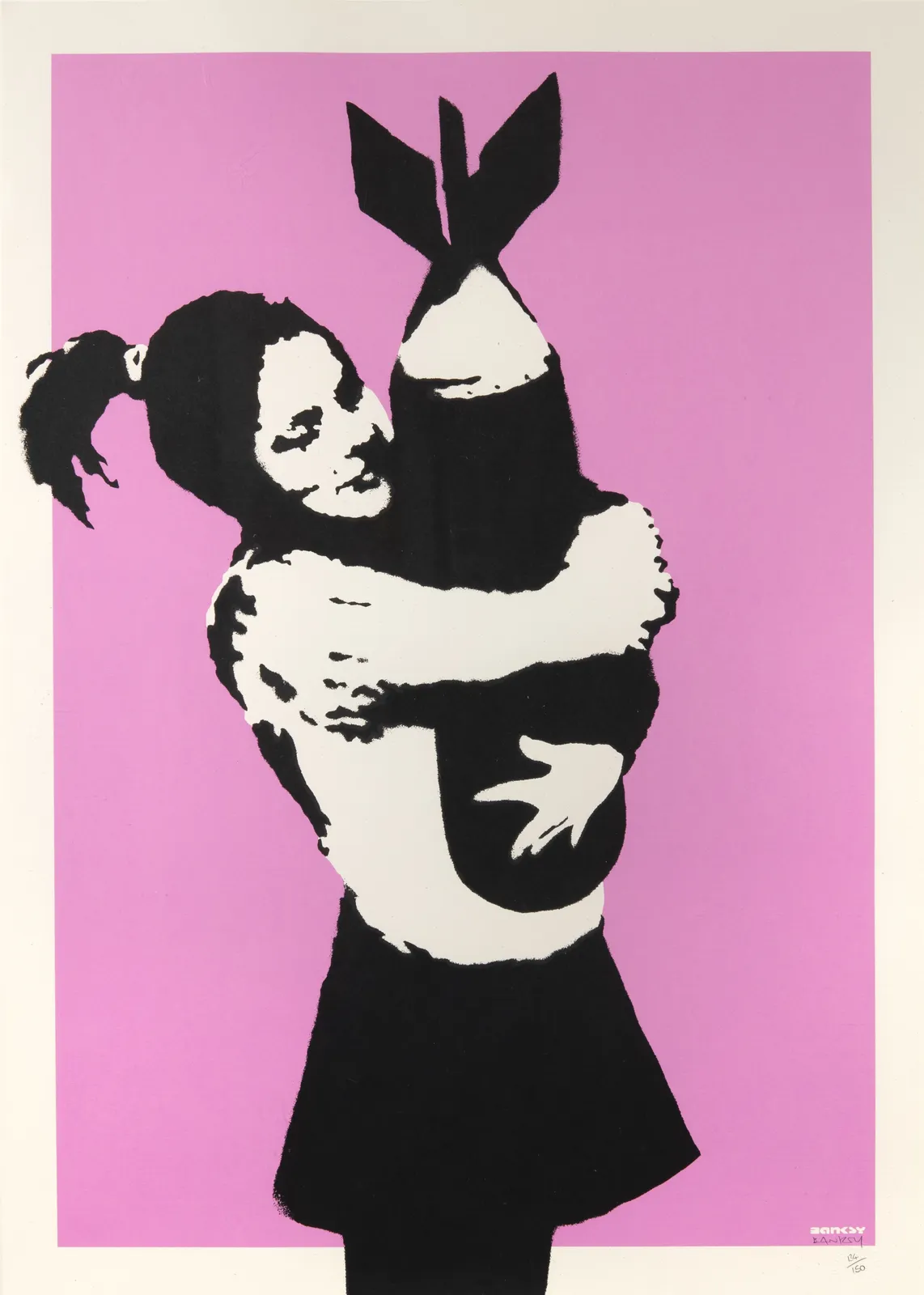
Issued in 2003, Bomb Hugger, also known as Bomb Love, brings together two sharply contrasting subjects: a young child and an aerial bomb. The print exemplifies Banksy’s use of immediately legible imagery to introduce unsettling questions about violence and its acceptance. Its publication during the year of the invasion of Iraq gives its anti-war associations particular historical resonance, without restricting the image to a single conflict.
Against a flat pink background, a girl embraces the bomb as though holding a cherished toy. The monochrome stencil treatment gives both figure and weapon a crisp graphic presence, while the surrounding colour lends the scene an incongruously reassuring tone. Her affectionate gesture transforms an instrument of destruction into an object of comfort, creating a tension between the emotional familiarity of the pose and the danger of what she holds.
Childhood provides the image with its moral and emotional force. The girl’s apparent trust can be read as a reflection on the normalisation of violence, suggesting how something threatening may become familiar through repeated exposure or reassuring presentation. Equally, her embrace permits a more hopeful interpretation: affection appears to confront aggression, proposing an imagined reconciliation between forces that should be irreconcilable.
The economy of the composition allows these competing readings to remain unresolved. Pink suggests tenderness, the embrace conveys attachment, and the bomb retains its destructive associations. By compressing this contradiction into a single encounter, Banksy creates an image whose accessibility sustains a broader reflection on innocence, protection and the ways in which societies accommodate the machinery of war.
This work is accompanied by a certificate of authenticity issued by Pest Control. A detailed condition report is available upon request.
Issued in 2003, Bomb Hugger, also known as Bomb Love, brings together two sharply contrasting subjects: a young child and an aerial bomb. The print exemplifies Banksy’s use of immediately legible imagery to introduce unsettling questions about violence and its acceptance. Its publication during the year of the invasion of Iraq gives its anti-war associations particular historical resonance, without restricting the image to a single conflict.
Against a flat pink background, a girl embraces the bomb as though holding a cherished toy. The monochrome stencil treatment gives both figure and weapon a crisp graphic presence, while the surrounding colour lends the scene an incongruously reassuring tone. Her affectionate gesture transforms an instrument of destruction into an object of comfort, creating a tension between the emotional familiarity of the pose and the danger of what she holds.
Childhood provides the image with its moral and emotional force. The girl’s apparent trust can be read as a reflection on the normalisation of violence, suggesting how something threatening may become familiar through repeated exposure or reassuring presentation. Equally, her embrace permits a more hopeful interpretation: affection appears to confront aggression, proposing an imagined reconciliation between forces that should be irreconcilable.
The economy of the composition allows these competing readings to remain unresolved. Pink suggests tenderness, the embrace conveys attachment, and the bomb retains its destructive associations. By compressing this contradiction into a single encounter, Banksy creates an image whose accessibility sustains a broader reflection on innocence, protection and the ways in which societies accommodate the machinery of war.
This work is accompanied by a certificate of authenticity issued by Pest Control. A detailed condition report is available upon request.
Provenance
Private Collection, UK 2003Private Collection, UK
Andipa 2012
Acquired from Andipa by a private collector 2012
Andipa 2025
Join Our Mailing List
* denotes required fields
We will process the personal data you have supplied to communicate with you in accordance with our Privacy Policy. You can unsubscribe or change your preferences at any time by clicking the link in our emails.